Industry News

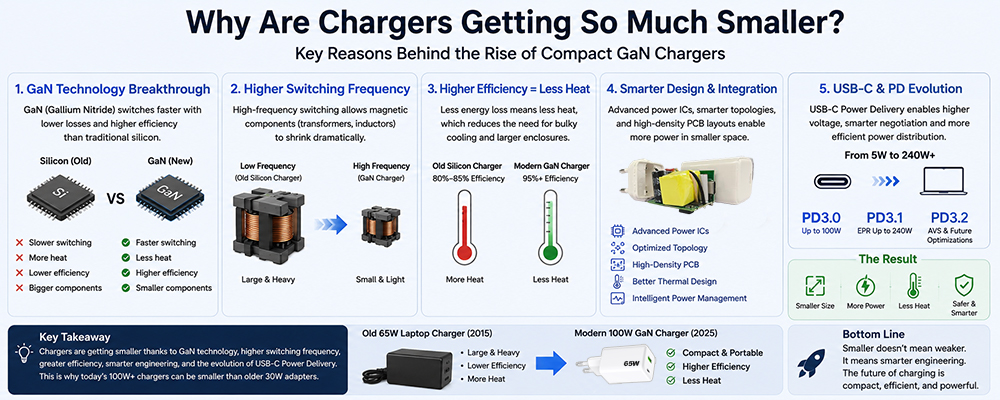
Why Are Chargers Getting So Much Smaller?

Views : 6
Update time : 2026-05-28 16:04:38
The Real Engineering Behind Tiny GaN Fast Chargers
A few years ago, a 65W laptop charger was a heavy brick that filled half your backpack.
Today?
A 100W USB-C GaN charger can fit in your pocket.
Even more surprising:
Some modern 140W and 240W chargers are now smaller than older 30W adapters.

So naturally, people keep asking:
• Why are chargers getting smaller?
• Is GaN really the reason?
• Are tiny chargers safe?
• Why do some GaN chargers still feel large?
• How can a charger shrink while power keeps increasing?
These questions appear constantly across Reddit, engineering forums, and tech communities because the size reduction feels almost unreal.
 
But the answer is not marketing magic.
It's actually a combination of:
• new semiconductor materials
• higher switching frequencies
• improved thermal engineering
• smarter circuit topology
• modern power-density optimization
In this article, ZX Power explains what is really happening inside today’s compact USB-C fast chargers — and why charger technology changed so dramatically in the past few years.
 

Chargers Used to Be Large for a Reason
Older chargers mainly relied on traditional silicon MOSFET technology.
These designs had several limitations:
• Lower switching efficiency
• Higher heat generation
• Larger transformers
• Bigger heatsinks
• Lower power density
As power increased, charger size increased almost proportionally.
For example:
Charger Era Typical Power Typical Size
Old phone charger 5W Small
Laptop brick 65W Very large
Gaming laptop adapter 180W–300W Extremely bulky
The biggest reason was heat.
Traditional silicon chargers wasted more energy during power conversion, and that wasted energy became heat.
More heat required:
• larger cooling space
• larger transformers
• larger safety spacing
• larger enclosures
 

Then GaN Technology Changed Everything
The biggest breakthrough came from:
GaN — Gallium Nitride
GaN is a semiconductor material increasingly replacing traditional silicon in modern power electronics.
Many Reddit engineers summarize it very simply↗ :
  • GaN really shines in high-frequency switching applications because it can switch much faster and with lower switching losses than traditional silicon MOSFETs.
  • That allows: - higher efficiency - smaller magnetics - smaller heatsinks - higher power density - more compact power supplies and converters.
That single engineering change affects almost every internal part of the charger.
 

Why Faster Switching Makes Chargers Smaller
This is the part most consumers never see.
Inside every charger are magnetic components such as:
• transformers
• inductors
• filters
These parts are traditionally among the largest components inside a charger.
 

Old Silicon Chargers
Traditional silicon transistors switch relatively slowly.
That means chargers need:
• larger transformers
• larger inductors
• larger capacitors
to handle power conversion safely.
 

GaN Chargers
GaN transistors can switch at much higher frequencies.
Higher switching frequency allows magnetic components to shrink dramatically.
That is one of the main reasons modern chargers became so compact.
It is not simply “better industrial design.”
It is physics.
 

Higher Efficiency = Less Heat
Another major reason chargers shrank is improved efficiency.
Modern GaN chargers often exceed:
95% efficiency
while many older silicon chargers operated closer to: 80%−85% efficiency
That efficiency difference matters more than people realize.
 

Where Does Lost Energy Go?
Mostly into heat.
If a charger wastes less energy:
• it generates less heat
• it requires smaller cooling structures
• it can use smaller enclosures
• components can be packed more tightly
This directly enables smaller charger bodies.
 

Why Some Tiny Chargers Still Feel Hot
This confuses many users.
People often assume:
 “Small charger = overheating”
Actually, many compact GaN chargers are technically operating more efficiently than older large chargers.
 
The reason they feel hotter is because:
Heat Density Increased
Modern chargers pack:
• more power
• more components
• higher wattage
into much smaller spaces.
So the heat becomes concentrated into a smaller surface area.
A compact 100W charger may feel warmer than an old 45W laptop brick even while wasting less total energy.
 

Why Some GaN Chargers Are Tiny — And Others Are Still Big
This is another important detail many buyers misunderstand.
Not all 
“GaN chargers” are engineered equally.
Reddit discussions often point this out clearly :
  • GaN only handles the switching side. The inductor is usually the biggest component and you need a topology change to shrink that.
  • Some brands just swap the GaN chip into an old layout and call it a day.

This is extremely important.
Simply adding a GaN chip does not automatically create a tiny charger.
Real miniaturization also requires:
• advanced PCB layout
• thermal redesign
• optimized transformer topology
• compact internal architecture
• high-density component placement
This is why some 100W GaN chargers are pocket-sized while others remain relatively bulky.
 

Multi-Port Chargers Also Became Smarter
Another reason chargers improved dramatically is power management IC development.
Modern chargers can intelligently distribute power across multiple ports.
Example:
Device Connection Power Allocation
Single laptop 100W
Laptop + phone 65W + 30W
3 devices Dynamic distribution
This dynamic allocation allows:
• fewer chargers
• fewer adapters
• smaller travel setups
instead of carrying multiple large power bricks.
 

USB-C Changed Charger Design Too
USB-C Power Delivery (PD) also accelerated charger miniaturization.
Older chargers often used:
• proprietary connectors
• fixed voltage systems
• inefficient power negotiation
 
USB-C PD introduced:
• intelligent voltage negotiation
• standardized fast charging
• higher voltage support
• more efficient delivery systems
 
New standards like:
• PD3.1 / EPR / AVS
now allow USB-C chargers to safely deliver up to 240W.
 

Are Smaller Chargers Safe?
This is one of the biggest concerns users have.
The answer:

High-quality compact chargers are generally very safe.
But only when proper engineering exists.
Good chargers include:
• over-voltage protection
• over-current protection
• thermal monitoring
• short-circuit protection
• intelligent temperature throttling
 
Poorly designed ultra-cheap chargers may cut corners on:
• insulation
• thermal spacing
• capacitors
• PCB quality
• protection ICs
That is why factory quality and certification matter heavily.
 

Why Gaming Laptop Chargers Are Still Sometimes Huge
Many users ask:
“If GaN exists, why are some gaming laptop chargers still enormous?”
The answer is more complicated than many people think.
Very high sustained power loads create serious thermal challenges.
For example:
• 240W gaming laptops
• GPU-heavy systems
• workstation laptops
may draw high power continuously for hours.
Compact chargers can technically deliver this power, but sustained thermal management becomes difficult.
That is why some manufacturers still prefer larger power bricks for long-duration stability.
 

The Future: Even Smaller, Higher-Power Chargers
The industry is still evolving rapidly.
Future trends include:
• 240W USB-C charging
• AI-controlled thermal optimization
• higher-density GaN ICs
• integrated power modules
• better cooling materials
• smarter dynamic power management
 
The next generation of chargers will likely become:
• smaller
• more efficient
• more intelligent
• more universal
all at the same time.
 

Final Thoughts
Chargers are getting smaller because power electronics technology fundamentally changed.
The biggest reasons include:
• GaN semiconductors
• higher switching frequency
• improved efficiency
• smaller magnetic components
• advanced thermal engineering
• USB-C PD evolution
• smarter PCB architecture
What looks like “magic” from the outside is actually years of progress in semiconductor engineering and power conversion design.

And despite their tiny size, modern high-quality GaN chargers are often:
• more powerful
• more efficient
• safer
• smarter
than the bulky adapters we used just a few years ago.
 
About ZX Power
ZX Power is a professional OEM & ODM charger manufacturer specializing in:
• GaN chargers
• USB-C PD chargers
• PPS & AVS charging systems
• Multi-port desktop chargers
• 20W–240W fast charging solutions
• Laptop and travel chargers
With extensive expertise in power electronics, thermal design, and high-density charging architecture, ZX Power provides advanced charging solutions for global B2B customers and consumer electronics brands.
 

FAQ
Q1: Why are modern chargers smaller than old chargers?
Modern chargers use GaN semiconductors, higher switching frequencies, and more efficient power conversion systems that reduce heat and allow smaller internal components.
 
Q2: What makes GaN chargers smaller?
A: GaN transistors switch faster and waste less energy as heat, allowing transformers, inductors, and cooling systems to shrink significantly.
 
Q3: Are smaller chargers more dangerous?
Next :
Related News
Read More >>
New Product | 70W GaN Type-C Charger New Product | 70W GaN Type-C Charger
May .25.2026
The most popular fast charger, GaN 70W USB-C charger, support PD PPS PD3.2 AVS for laptops and iPhone 17 pro max, SFC3.0 for Samsung S26 Ultra and future models.
ZONSAN PD Charger Manufacturer ZONSAN PD Charger Manufacturer
May .16.2026
We ZONSAN are professional PD charger manufacturer over 17 years, with BSCI / KC / GS / ISO 9001 approval
Newsletter